What Are AI Agents? The Technology That Could Transform Every Business in 2026
AI agents are rapidly becoming the biggest technology trend of 2026. Learn what AI agents are, how they differ from traditional AI tools, and why businesses are investing heavily in this next wave of automation.
What Are AI Agents? The Technology That Could Transform Every Business in 2026
Over the past few years, artificial intelligence has evolved from a futuristic concept into an essential business tool. Companies worldwide are using AI for content creation, customer support, coding, data analysis, and marketing.
However, a new wave of innovation is beginning to reshape the technology landscape: AI Agents.
Industry leaders, technology analysts, and enterprise organizations are increasingly viewing AI agents as the next major leap in artificial intelligence. Instead of simply responding to prompts, these systems can perform tasks, make decisions, use software tools, and complete complex workflows with minimal human involvement.
For businesses, this could represent one of the most significant productivity shifts since the rise of cloud computing.
What Is an AI Agent?
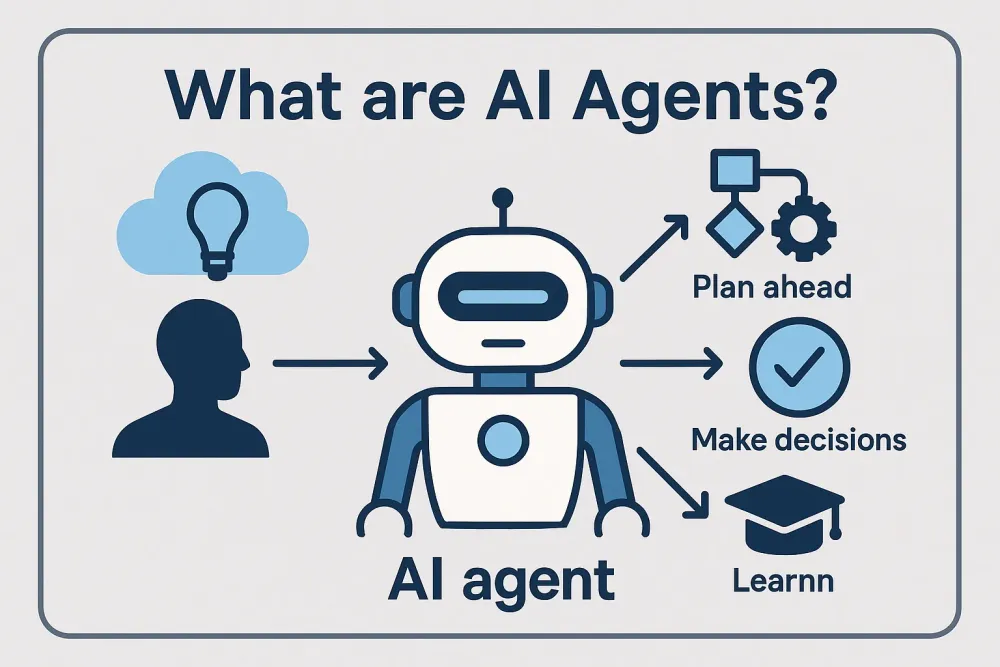
An AI agent is a software system that can understand goals, plan actions, use tools, gather information, and execute tasks autonomously.
Traditional AI systems typically work in a request-and-response format.
For example:
Ask ChatGPT to write an email.
Receive the email.
Copy it manually.
Send it yourself.
An AI agent can go much further.
Imagine giving an AI the instruction:
"Research our competitors, prepare a report, summarize the findings, create a presentation, and email it to the team."
Instead of handling a single task, an AI agent can coordinate multiple actions to achieve the desired outcome.
Why AI Agents Are Different From Chatbots
Many people confuse AI agents with chatbots.
The difference is significant.
A chatbot primarily generates responses.
An AI agent can:
Access databases
Search the web
Analyze information
Use software applications
Execute workflows
Monitor outcomes
Make decisions based on predefined objectives
Think of a chatbot as an assistant that answers questions.
Think of an AI agent as a digital worker that can actually perform tasks.
Why Businesses Are Paying Attention
Organizations are increasingly looking for ways to improve efficiency without continuously increasing operational costs.
AI agents offer a compelling solution because they can automate complex processes that traditionally required multiple employees or departments.
Some potential benefits include:
Faster Operations
AI agents can perform tasks around the clock without waiting for business hours.
Improved Productivity
Employees can focus on strategy and decision-making while repetitive work is automated.
Lower Costs
Businesses can reduce the amount of manual effort required for routine operations.
Better Scalability
Organizations can handle growing workloads without proportionally increasing headcount.
Real-World Applications of AI Agents
Customer Support
AI agents can answer questions, retrieve information, process requests, and escalate issues when necessary.
This helps businesses provide faster customer service while reducing support workloads.
Marketing
Marketing teams are already experimenting with AI agents that can:
Research topics
Generate content ideas
Analyze competitors
Monitor campaign performance
Create reports
Suggest optimization opportunities
Sales
AI agents can:
Qualify leads
Research prospects
Update CRM systems
Draft personalized outreach messages
Schedule follow-ups
This allows sales teams to focus on relationship-building and closing deals.
E-Commerce
Online businesses can use AI agents for:
Inventory monitoring
Customer support
Product recommendations
Review analysis
Marketing automation
Performance reporting
For growing D2C brands, these capabilities can significantly improve operational efficiency.
The Rise of Multi-Agent Systems
One of the most exciting developments in artificial intelligence is the emergence of multi-agent systems.
Instead of relying on a single AI agent, organizations can deploy multiple specialized agents working together.
For example:
A research agent gathers information.
A content agent creates articles.
An SEO agent optimizes content.
An analytics agent measures performance.
Together, they function like a coordinated digital team.
This approach is increasingly being viewed as a major trend in enterprise AI adoption.
Challenges Businesses Must Consider
Despite their potential, AI agents are not magic solutions.
Organizations should carefully evaluate:
Data Quality
AI systems are only as effective as the information they can access.
Security
Sensitive business and customer data must remain protected.
Governance
Clear rules and oversight are necessary to ensure responsible AI usage.
Human Supervision
Important business decisions should still involve human judgment and accountability.
The most successful implementations will combine AI capabilities with human expertise.
What the Future Looks Like
Over the next few years, AI agents are expected to become increasingly capable.
Future systems may:
Manage entire business processes
Coordinate with other AI agents
Operate across multiple software platforms
Continuously optimize workflows
Deliver personalized customer experiences at scale
Many technology experts believe businesses will eventually rely on networks of specialized AI agents in the same way they currently rely on software applications.
Final Thoughts
AI agents represent a major shift in how businesses think about automation.
Rather than simply assisting employees with isolated tasks, these systems have the potential to become active participants in day-to-day operations.
Companies that begin understanding and experimenting with AI agents today will be better positioned to take advantage of the opportunities emerging over the next decade.
While the technology is still evolving, one thing is becoming increasingly clear:
The future of business automation is not just AI.
It is AI that can think, act, and execute.