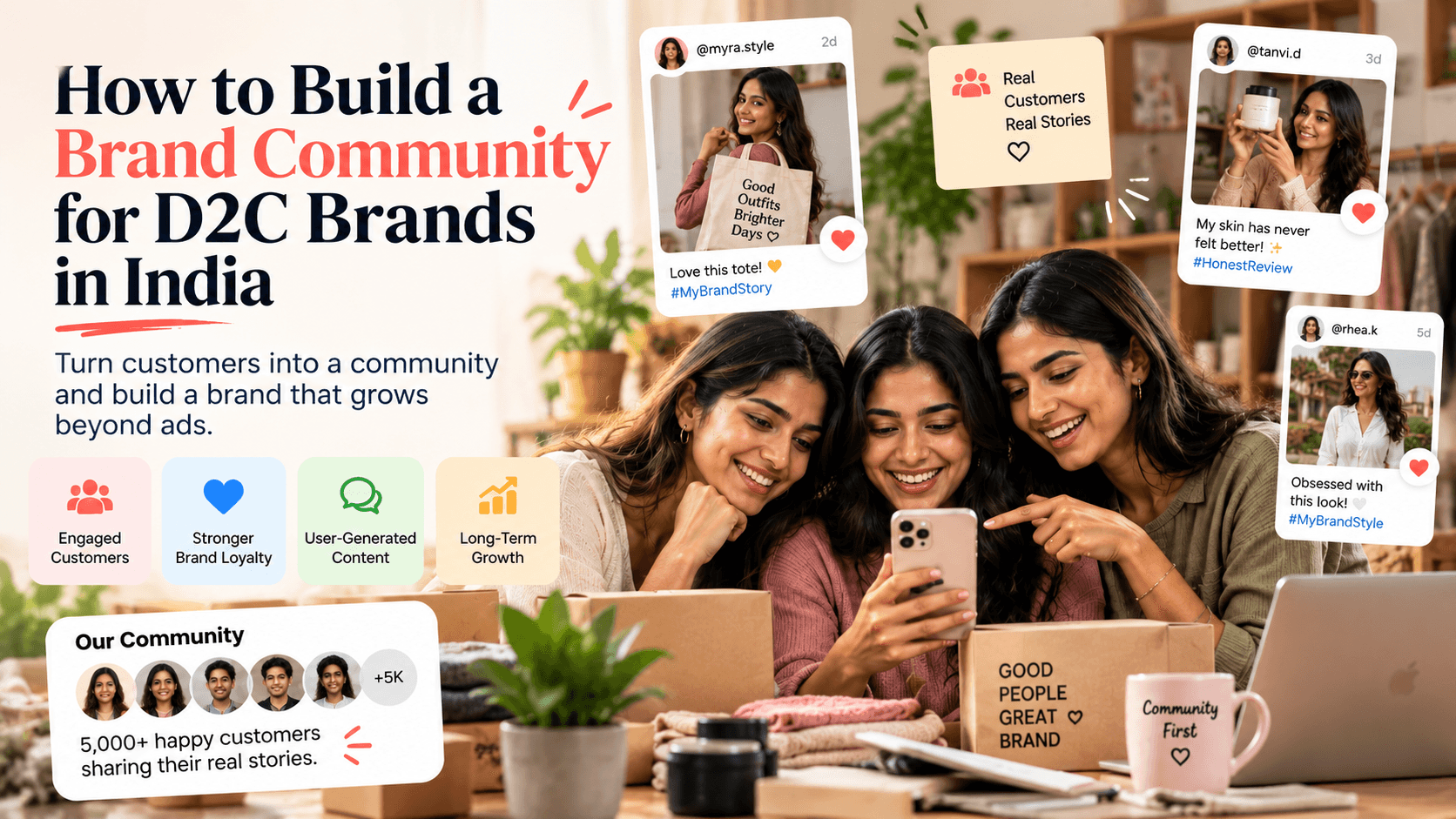
Anyone can buy reach. Run enough ads and people will see your brand. But reach disappears the moment you stop paying for it.
A community doesn't. Customers who feel connected to your brand buy again, forgive the occasional delay, defend you in the comments and bring their friends. In a market where every category is crowded and ad costs keep rising, that loyalty is the strongest moat a D2C brand can build.
The short version: get clear on who you're for and what you stand for, talk like your customers talk, give people reasons to participate, and show up consistently, long before you ask them to buy.
Why community matters more than ever
- Ads are getting more expensive. A customer who buys three times is worth far more than one who buys once, and community drives repeat purchase.
- People trust people. Reviews, customer photos and word of mouth persuade better than any brand claim.
- It fuels your content. A real community gives you endless UGC, feedback and ideas for what to make next.
- It's hard to copy. Competitors can copy your product and your ads. They can't copy the relationships you've built.
Step 1: Get your positioning right
A community forms around a shared identity. Before posting anything, answer these clearly:
- Who exactly is this for? Not "women 18–45," but "working women who want ethnic wear they can wear to the office."
- What do they care about beyond the product? Sustainability, craftsmanship, self-expression, fitness, value, heritage?
- What do we believe that others in our category don't?
- How should people feel when they interact with us?
If you can't describe your brand in one sentence without mentioning the product, keep working on this step. Everything else builds on it.
Step 2: Learn your audience's language
The fastest way to make people feel understood is to use their words, not marketing words.
- Read every review, DM and comment, yours and your competitors'
- Note the exact phrases customers use to describe their problems and wins
- Listen to how they talk: English, Hinglish, regional language, formal or casual
- Use those phrases in captions, product pages and ads
When a customer reads your post and thinks "that's exactly how I'd say it," you've earned attention.
Step 3: Choose where your community lives
Don't try to be everywhere. Pick one or two places and show up properly.
| Platform | Best for | How to use it |
|---|---|---|
| Discovery, visual storytelling | Reels, carousels, Stories with polls and questions, replying to every comment | |
| Close relationships, repeat purchase | Broadcasts or Channels for launches, personal support, early access for loyal customers | |
| YouTube | Depth and trust | Tutorials, behind-the-scenes, longer founder stories |
| Founder-led brands, B2B | Founder's journey, lessons, building in public | |
| Offline | Deep loyalty | Pop-ups, workshops, meetups in your top cities |
For most Indian D2C brands, Instagram for discovery plus WhatsApp for relationships is the strongest starting combination.
Step 4: Create content that invites participation
Community content isn't about you. It's about them.
- Customer spotlights: repost customer photos and stories (with permission)
- Behind the scenes: how products are made, the team, the mistakes
- Ask for input: "Which colour should we launch next?", then actually launch it
- Challenges and trends: give people a reason to create with your brand
- Useful content: styling tips, how-tos and guides that help even if they never buy
- Founder voice: people connect with people. Let the founder be visible
A simple rule of thumb: for every post that sells, publish several that entertain, educate or celebrate your customers.
Step 5: Turn conversations into relationships
This is the part most brands skip, and it's where communities are really built.
- Reply to every comment and DM, personally and quickly, especially in the early days
- Remember people. Recognise repeat customers and regular commenters
- Handle complaints publicly and kindly. A well-handled problem builds more trust than no problem at all
- Reward loyalty: early access, thank-you notes, surprise gifts, a VIP WhatsApp group
- Close the loop: when you act on feedback, tell people. "You asked, we built it" is powerful
Step 6: Make your customers the heroes
Your best marketing is a happy customer talking about you.
- Make it easy to share: beautiful packaging, a branded hashtag, a thank-you card that invites a post
- Ask happy customers for reviews and photos at the right moment, after delivery, not at checkout
- Build a creator and ambassador programme from your most loyal customers
- Feature customer content on your website, in ads and on product pages
How to measure community (beyond follower count)
Followers are a vanity metric. Track signals that show real connection:
- Comments and DMs per post: are people talking back?
- Saves and shares: is your content worth keeping and passing on?
- User-generated content: how many customers post about you unprompted?
- Repeat purchase rate: do customers come back?
- Referral and word of mouth: "How did you hear about us?" at checkout
- Sentiment: what's the tone of comments and reviews?
Common mistakes to avoid
- Treating social media as a catalogue and only posting products
- Buying followers or engagement, which damages reach and trust
- Posting consistently for a month, then disappearing
- Ignoring comments, or replying with copy-pasted answers
- Changing your voice and positioning every few weeks
The bottom line
Community is built slowly, then pays off quickly. Clear positioning, your customers' language, content that invites participation and genuine conversations compound over time into a brand people choose again and again, and ads that work harder because people already trust you.
At Dibiz Studio, we help D2C brands find their positioning, shape their voice and build communities that make people care, not just follow. Talk to us about your brand.
Frequently asked questions
What is the difference between followers and a community?
Followers watch. A community participates. Community members comment, share, create content about you, recommend you to friends and buy again. You can buy followers with ads; you earn a community through consistent value and real conversations.
Which platform is best for building a D2C community in India?
Most Indian D2C brands start with Instagram for discovery and WhatsApp for closer relationships, since that's where their customers already spend time. Add a platform only when you can show up there consistently.
How long does it take to build a brand community?
Expect months, not weeks. Early signs, such as more comments, DMs, customer photos and repeat buyers, often appear within the first few months if you post consistently and reply to people personally.
Can a small brand build a community without a big budget?
Yes. Community is built more with attention than with money: replying to every comment, featuring customers, asking for input on products and showing the people behind the brand. Small brands often do this better than big ones.
Want this done for your brand?
Get a free growth audit. We'll review your ads, content and website and show you exactly where revenue is leaking.