"Our ROAS is terrible. Should we change agencies? Try Google instead? Stop ads completely?"
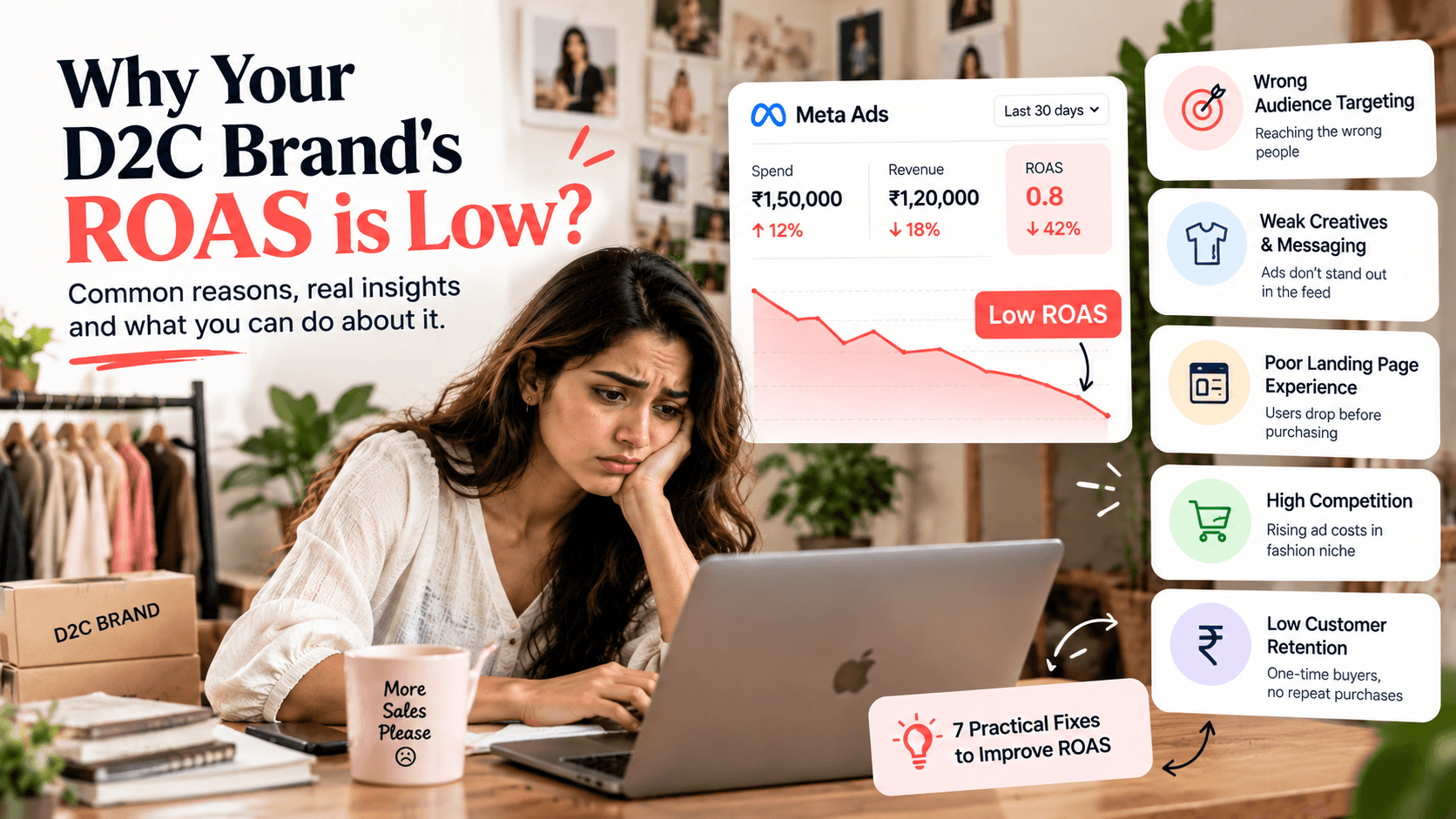
We hear this from D2C founders every week. In most cases, the ads aren't the only problem. Return on ad spend is the result of your whole funnel: tracking, creative, offer, website and product economics. Fix only the ads and ROAS usually stays stuck.
Here are the seven reasons we see most often, roughly in the order you should check them.
1. Your tracking is broken
If the platform cannot see your sales, it cannot optimise for buyers, and your reported ROAS will look worse than reality.
Signs: orders in Shopify are much higher than purchases reported in Ads Manager, or purchase events are duplicated.
Fix:
- Confirm the Meta Pixel and Conversions API are both active and deduplicated
- Check Google Ads conversion tracking and enhanced conversions
- Place a test order after any theme, app or checkout change
- Compare platform-reported purchases against real orders every week
2. You don't know your break-even ROAS
Many brands chase a ROAS of "4x" because someone told them it was good. The number that matters is your break-even point.
Fix: calculate it.
Break-even ROAS = 1 ÷ (gross margin after product cost, shipping, payment fees and expected returns)
If your true margin is 40%, your break-even ROAS is 2.5. Anything above that is profit, before fixed costs. Include RTO on COD orders: for many Indian brands this alone moves the number significantly.
3. Your creatives are tired (or never persuaded anyone)
Creative is the biggest lever in modern performance marketing. Two common patterns:
- Fatigue: a winning ad has run for weeks, frequency is climbing and click-through rate is falling
- Weak angles: ads look beautiful but say nothing that makes people want to buy
Fix: build a creative testing system. Launch new creatives weekly, test different angles (problem, occasion, social proof, offer, founder story), and judge them on thumb-stop rate and click-through rate before cost per purchase. Most brands need far more creative volume than they think.
4. Your audience setup is fighting the algorithm
Heavily segmented accounts with many small ad sets, narrow interests and overlapping audiences starve each ad set of data. Nothing exits the learning phase and costs stay high.
Fix: consolidate. Fewer campaigns, broader targeting, larger budgets per ad set. Let strong creatives find the right buyers.
5. Your website is leaking buyers
If people click and add to cart but don't buy, no amount of ad optimisation will help.
Check these first:
- Mobile page speed. Most paid traffic is on phones. Heavy images and apps slow stores down
- Product pages. Clear photos, real people using the product, size and fit guidance, reviews
- Trust. Return policy, delivery timelines and contact details visible before checkout
- Checkout friction. Surprise shipping costs, forced account creation, limited payment options
- Message match. The landing page should continue the promise the ad made
A small improvement in conversion rate raises ROAS on every rupee you spend, without touching the ads.
6. Your offer isn't compelling enough
Sometimes the product is good, the ads are good, and the offer still isn't strong enough to make a stranger buy from a brand they have never heard of.
Fix: test offers deliberately. Bundles, free shipping thresholds, a first-order incentive, gift-with-purchase or a strong guarantee often beat blanket discounts and protect margins better.
7. You're scaling too fast, or at the wrong time
Doubling budgets overnight often resets learning and spikes costs. And during peak seasons like Diwali, the cost of reaching people rises for everyone.
Fix: increase budgets gradually (around 15–20% every few days), add proven creatives as you scale, and plan festive campaigns weeks in advance with warm audiences and a stocked creative bank.
A quick diagnostic checklist
Work through this in order. Stop at the first "no" and fix it before moving on:
- Do platform-reported purchases roughly match real orders?
- Do you know your break-even ROAS, including returns and RTO?
- Have you launched new creatives in the last two weeks?
- Is your account consolidated into a few well-funded campaigns?
- Is your mobile conversion rate healthy and your checkout friction-free?
- Is your offer strong enough for a first-time buyer?
- Are you scaling budgets gradually?
Don't forget retention
ROAS measures only the first order. A customer who buys three times a year is worth far more than one who buys once. Email, WhatsApp flows and a good post-purchase experience mean you can afford a lower first-order ROAS and still grow profitably. That is the difference between brands that scale and brands that stall.
Need help finding the leak?
This is exactly what our audit covers at Dibiz Studio: tracking, creatives, account structure, website conversion and retention. We find where growth is breaking before recommending more spend. See how we work.
Frequently asked questions
What is a good ROAS for a D2C brand in India?
There is no universal number. A good ROAS is one above your break-even ROAS, which depends on your margins, shipping, returns and payment costs. A brand with 70% margins can be very profitable at 2x, while a brand with 35% margins may lose money at 3x.
Why did my ROAS suddenly drop?
The most common causes are creative fatigue, a tracking break (for example after a theme or checkout change), a sudden budget increase that reset learning, seasonal competition such as the festive season, or a website change that hurt conversion. Check them in that order.
Is Meta's reported ROAS accurate?
It is a useful guide but not the full picture. Attribution windows, iOS privacy limits and COD returns mean platform ROAS and real profit can differ. Track blended metrics too: total revenue divided by total ad spend, and profit after returns.
Want this done for your brand?
Get a free growth audit. We'll review your ads, content and website and show you exactly where revenue is leaking.