Your website is the one marketing asset you fully own. Ads send people there, content builds trust, but the website is where the sale actually happens. Choose the wrong platform and you pay for it every month in lost conversions, slow pages and workarounds.
So which should a D2C brand build: a Shopify store, a fully custom website, or something in between? Here's a straight comparison, with no platform loyalty.
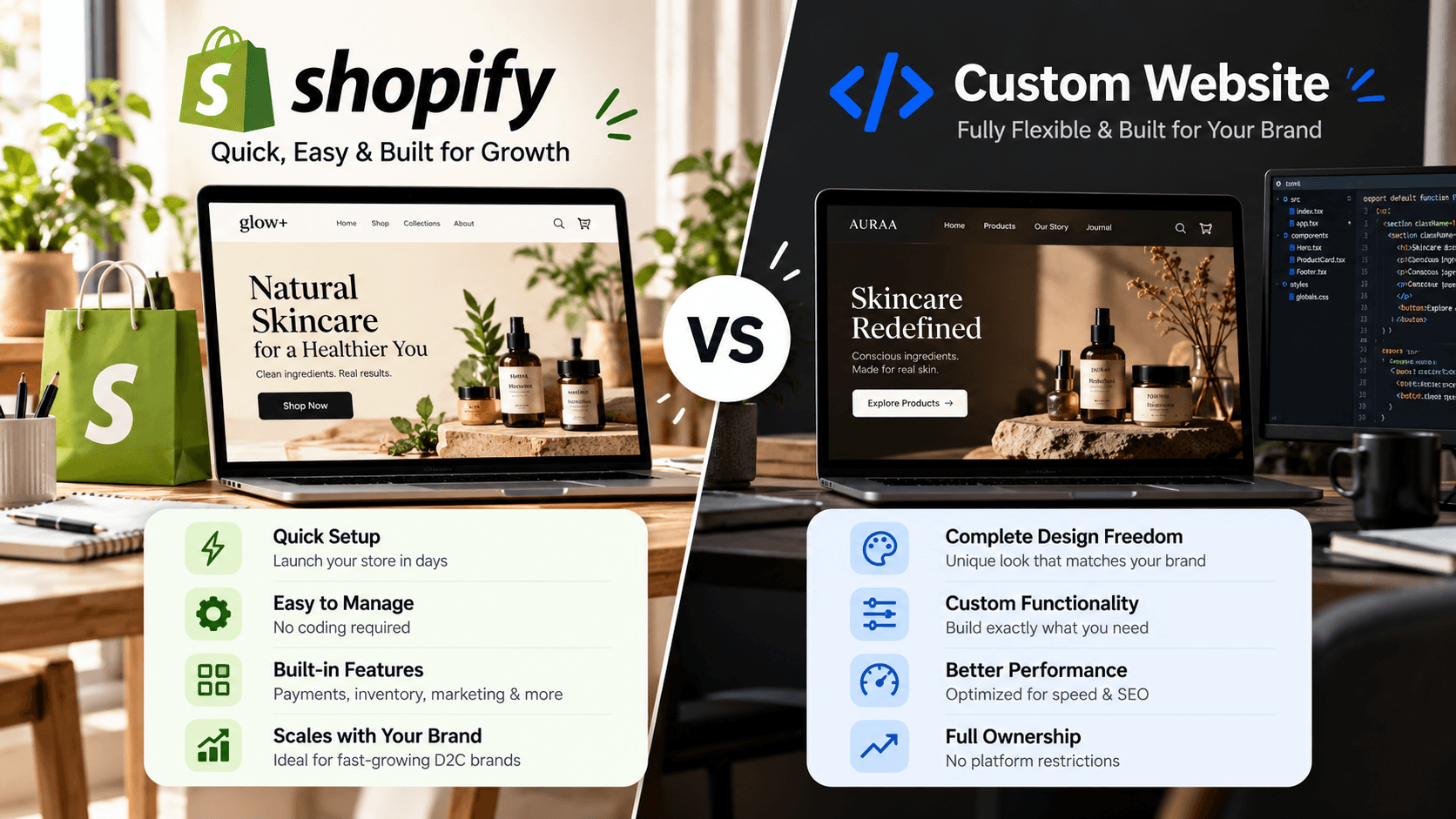
The short answer: start on Shopify with a strong, conversion-focused design. Move to a headless or custom build when your brand, speed or feature needs outgrow what a theme can do.
The three options, explained simply
1. Shopify with a theme
You pick a theme, customise it and add apps for extra features. Shopify runs the hosting, checkout, payments and security.
Best for: new and growing brands that need to launch fast and sell reliably.
2. Fully custom website
Designed and coded from scratch, often with a framework like Next.js (the same technology behind many of the fastest brand sites on the web), connected to your own backend, payment gateway and inventory system.
Best for: brands with unique requirements, such as custom booking flows, configurators, marketplaces, or experiences that are more than a catalogue.
3. Headless: Shopify backend + custom front end
Shopify still manages products, orders and checkout. The part customers see is a custom-built Next.js site. You get Shopify's reliability with complete freedom over design and performance.
Best for: established brands that want a premium, fast, story-led experience without rebuilding commerce from scratch.
Side-by-side comparison
| Shopify theme | Headless (Shopify + Next.js) | Fully custom | |
|---|---|---|---|
| Time to launch | Fastest | Medium | Longest |
| Upfront cost | Lowest | Medium to high | Highest |
| Design freedom | Limited by theme | Complete | Complete |
| Page speed | Good, drops as apps pile up | Excellent | Excellent, if built well |
| Checkout & payments | Built in, trusted | Shopify checkout | You build and maintain it |
| Ease of editing | Very easy | Easy with a CMS | Depends on the build |
| Ongoing maintenance | Low | Medium | Highest |
| Best stage | Launch → early growth | Growth → scale | Unique business models |
Signs you've outgrown your current website
- Pages feel slow on mobile, especially product and collection pages
- You're running 15+ apps and each one adds scripts and monthly fees
- Your ads get clicks, but add-to-cart and checkout rates stay low
- The site looks like every other theme in your category
- You can't build the experience you want: lookbooks, bundles, quizzes, size finders, storytelling pages
- Your team avoids updating the site because it's painful to edit
If three or more sound familiar, it's time for a redesign, and possibly a new platform.
What actually makes a D2C website convert
Platform matters less than most people think. These matter more:
Speed
Compress and properly size images, lazy-load anything below the fold, limit third-party scripts and remove apps you don't use. Test on a real mid-range Android phone, not just your laptop.
A clear first screen
Within a few seconds, a visitor should know what you sell, who it's for and why it's different, with one obvious next step.
Product pages that answer every question
- Real photos and short videos of people using the product
- Size and fit guidance (fewer returns, more confidence)
- Reviews with photos
- Delivery timelines, return policy and COD availability close to the Add to Cart button
A frictionless checkout
Guest checkout, UPI and COD options, no surprise shipping fees and as few fields as possible.
Message match with your ads
If an ad promises "kurtas that don't fade," the landing page should say the same thing in the first line. Dedicated landing pages for key campaigns often outperform sending all traffic to the homepage.
Built for SEO from day one
Clean URLs, unique page titles and descriptions, structured data, fast load times and a blog, so the site brings in free traffic, not just paid traffic.
How to choose: a quick decision guide
- Just launching or under steady monthly revenue? → Shopify with a well-designed, customised theme.
- Growing fast, spending seriously on ads, brand-led category (fashion, beauty, lifestyle)? → Consider headless: Shopify + Next.js.
- Your business model isn't a standard store (services, bookings, subscriptions with complex logic, marketplaces, apps)? → Fully custom.
Whatever you choose, plan the buying journey first: what the customer needs to see, in what order, to feel confident enough to buy. Pages and features come after that.
How we build websites at Dibiz Studio
We design buying journeys, not just pages. Every website project covers:
- Strategy & UX: customer journey, page structure and messaging, based on your audience and ad data
- Design: custom, brand-first UI for mobile and desktop
- Development: Shopify stores, headless Shopify + Next.js builds, and fully custom websites and web apps
- Performance & SEO: fast pages, technical SEO and analytics set up from day one
- Conversion optimisation: product pages, landing pages and checkout built to sell, then improved using real data
Because we also run ads and produce content for D2C brands, we build websites that work with your marketing, not separately from it.
Thinking about a new website or a redesign? Book a free discovery call and we'll review your current site and recommend the right platform for your stage.
Frequently asked questions
Is Shopify good enough for a D2C brand in India?
For most early and growing D2C brands, yes. Shopify handles payments, COD, inventory, shipping integrations and apps out of the box, so you can launch fast and focus on selling. Brands usually outgrow a standard theme, not Shopify itself.
When should a brand move to a custom or headless website?
When the theme is limiting you: slow pages because of too many apps, a brand experience a theme cannot deliver, complex product configurators, content-heavy storytelling, or multiple storefronts and markets. At that point a headless setup (Shopify backend with a custom Next.js front end) often gives the best of both.
Does a faster website really increase sales?
Speed affects both conversion and ad performance. Most D2C traffic is on mobile and often on patchy connections, so slow pages lose shoppers before they see the product. A fast site also improves landing page experience, which helps your paid campaigns.
How long does it take to build a D2C website?
A well-planned Shopify store with a customised theme typically takes a few weeks. A fully custom or headless build takes longer because design, development and integrations are built from scratch. Timelines depend mostly on how ready your content, photography and product data are.
Can you redesign our existing website without losing SEO?
Yes, if the migration is planned. Keep URL structures where possible, set up 301 redirects for every changed URL, carry over titles and descriptions, and resubmit the sitemap in Google Search Console after launch.
Want this done for your brand?
Get a free growth audit. We'll review your ads, content and website and show you exactly where revenue is leaking.