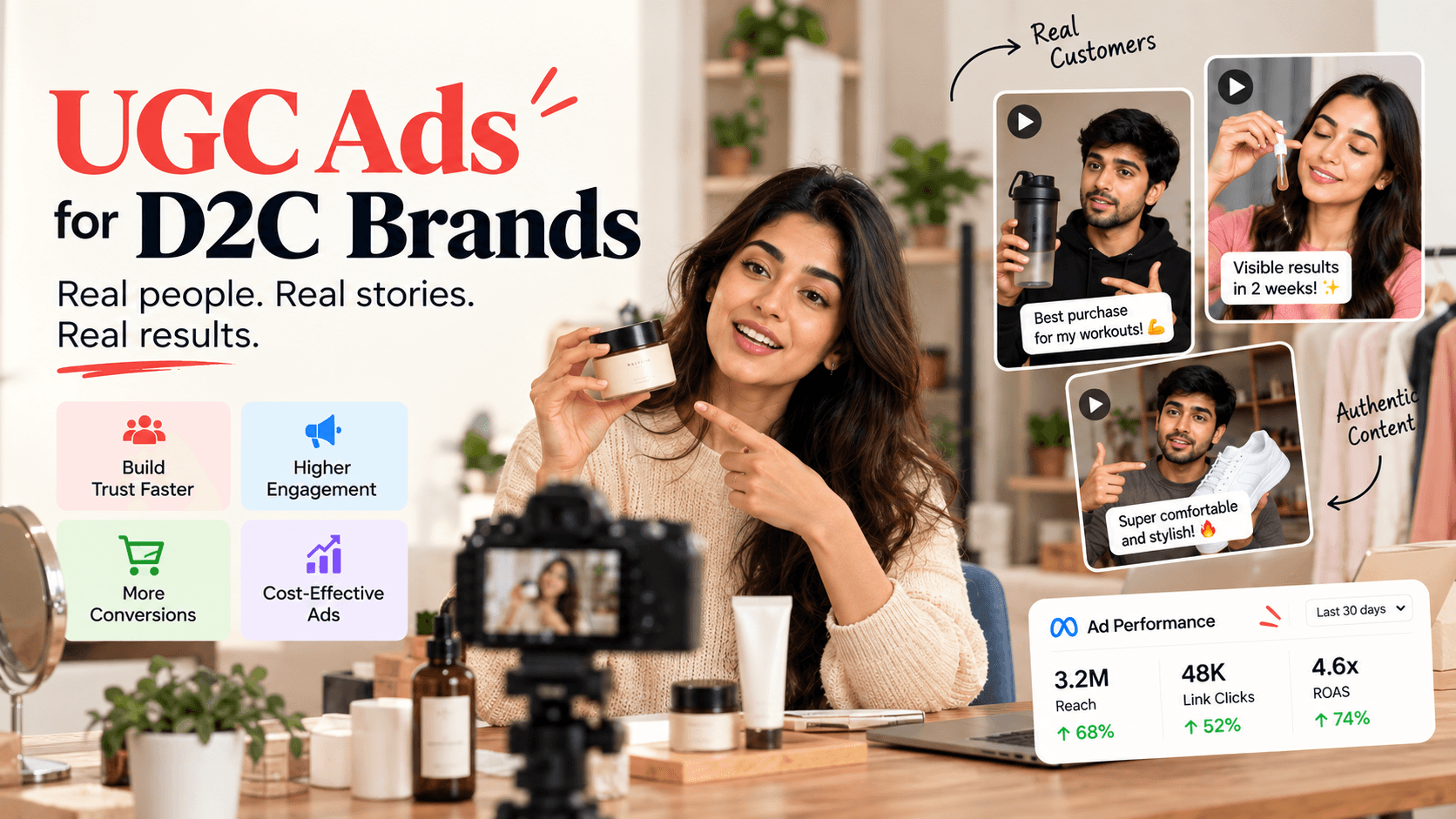
Scroll through Instagram for a minute and notice which ads you actually stop for. Chances are they don't look like ads at all. They look like a real person holding a product and talking to you.
That's UGC, or user-generated content, and for many D2C brands it has become the most reliable creative format on Meta, YouTube Shorts and beyond.
What is a UGC ad?
A UGC ad is an advert made to look and feel like content from a real customer or creator:
- Filmed vertically on a phone
- Spoken in natural, everyday language (often Hinglish or a regional language)
- Showing the product being used in real life
- Native to the platform, so it blends into the feed rather than interrupting it
It can be made by actual customers, or by creators you pay to make content in that style. The second is more common for ads because you control the brief, quality and usage rights.
Why UGC works so well
It borrows trust. People trust other people more than they trust brands. A real person saying "I've used this for a month" is more believable than a polished tagline.
It stops the scroll. Feeds are full of friends and creators. Content that looks similar gets watched instead of skipped.
It's fast and affordable to test. You can produce many variations of hooks and angles for the cost of a single studio shoot. Since creative testing is how you find winning ads, volume matters.
It shows the product in action. Fit, texture, size, results: things a flat product photo can't communicate.
UGC formats worth testing
- Testimonial or review: "I was sceptical, but…" A creator shares their honest experience.
- Unboxing: first impressions, packaging, the moment of discovery.
- Problem → solution: open with a relatable frustration, then show the product solving it.
- Try-on or demo: ideal for fashion, beauty and gadgets. Show fit, application or features.
- "3 reasons I love this": a quick, list-style structure that's easy to follow.
- Comparison: "What ₹999 gets you from us vs a typical brand" (keep it fair and accurate).
- Street-style or reaction: ask people to try or react to the product.
- Founder UGC: the founder filming on their phone, explaining why the product exists.
Anatomy of a UGC ad that converts
The hook (0–3 seconds)
This decides everything. Strong hooks include:
- A bold claim: "This is the only kurta I've re-bought three times"
- A question: "Why does nobody talk about this?"
- A relatable pain: "If your hair frizzes the moment you step outside…"
- A visual pattern-break: dropping the product into frame, an unexpected setting
Always test several hooks on the same video body. It's the cheapest way to multiply your winners.
The body (3–20 seconds)
Show, don't just tell. Demonstrate the product, highlight one or two key benefits and address the biggest objection (price, quality, fit, delivery time).
The call to action (last 3–5 seconds)
Tell people exactly what to do: "Tap Shop Now," "Use code FIRST10," "Link's right below." Add on-screen text too, since many people watch without sound.
How to brief creators (template)
A good brief gives creators direction without turning them into actors reading a script. Share:
- Product: what it is, who it's for, the price
- Key message: the one thing viewers must remember
- Angle: which format from the list above
- Must-show moments: close-up of texture, the product in use, packaging
- Hooks to try: 2–3 options they can say in their own words
- Objection to address: e.g. "Is it worth the price?"
- Do's and don'ts: no competitor names, no unverifiable medical or performance claims
- Technical specs: 9:16 vertical, good natural light, clear audio, raw files plus edited version
- Usage rights: paid ads, platforms, duration
Editing tips that lift performance
- Captions on everything. Big, readable, in the safe zone away from buttons
- Cut dead air. Keep pacing fast, with a new visual every 2–3 seconds
- Add proof on screen: ratings, number of reviews, "Made in India," delivery promises
- Make variations: the same body with different hooks, lengths (15s, 30s) and CTAs
Measuring UGC performance
Judge each video on:
- Thumb-stop rate: 3-second views ÷ impressions. Is the hook working?
- Hold rate: how many watch past 50%. Is the body interesting?
- Click-through rate: does it make people want to know more?
- Cost per purchase and ROAS: does it actually sell?
When a video wins, don't just scale it. Understand why it won and brief the next batch around the same angle with fresh hooks and new creators.
Common UGC mistakes
- Over-scripting, so it sounds like an ad anyway
- Using only one creator. Different faces reach different audiences
- Beautiful footage with no clear hook
- Forgetting captions
- Running content without proper usage rights
Ready to build a UGC engine?
At Dibiz Studio, content production is built to test decisions, not just look good. We script, source creators, shoot and edit UGC and ad creatives for D2C brands, then use performance data to decide what to make next. Explore our services.
Frequently asked questions
What is a UGC ad?
A UGC (user-generated content) ad is an advert that looks and feels like content a real customer or creator made: filmed on a phone, spoken in their own words, and native to platforms like Instagram Reels. It can be made by actual customers or by creators paid to make content in that style.
Are UGC ads better than professional shoots?
For direct-response ads on social media, UGC-style videos often perform better because they feel trustworthy and blend into the feed. Professional shoots are still valuable for brand pages, website imagery and launches. Most strong brands use both.
Do we need the creator's permission to run their content as an ad?
Yes. Always get written usage rights that cover paid advertising, the platforms and the duration. For customer posts, ask permission before using them. Many brands use partnership ads so the ad runs from the creator's handle with their approval.
How many UGC videos should a brand test?
Enough to test several angles at once. A practical starting point is 5–10 videos across 3–4 different angles and 2–3 creators, then produce more variations of whatever wins.
Want this done for your brand?
Get a free growth audit. We'll review your ads, content and website and show you exactly where revenue is leaking.